Research Quality Lab GPT-5.6 Build Week Project

From Manuscript Readiness to Research Visibility

Research Quality Lab combines human-led GPT-5.6 manuscript-readiness assessment with an accessible Paper-to-Video and Audio workflow for journals, authors and research organizations.

Assess responsibly. Decide humanly. Communicate research accessibly.

Three-minute demonstration

See the complete workflow

Follow a synthetic manuscript from secure editorial assessment through human decision-making and into accessible research media.

The challenge

Research faces two connected barriers

Is the manuscript ready to proceed?

Journals receive potentially valuable work that may still contain structural, language, ethics, authorship, completeness or presentation problems.

Editors need structured assistance, but an AI system must not replace editorial judgment or silently determine a manuscript's outcome.
How can the research reach more people?

Producing a narrated research video normally requires scriptwriting, voice production, visual sourcing, scene design, editing and rendering skills.

Many researchers and journals do not have the time, staff or production experience required to complete this process.

The solution

Two copilots inside one research platform

A

GPT-5.6 Editorial Readiness Copilot

Securely analyzes a manuscript and prepares evidence-based internal guidance for an authorized editor.

  • Assesses scope, structure and academic basis
  • Flags language, ethics and authorship concerns
  • Suggests an editable A/B/C/D readiness outcome
  • Separates internal evidence from author communication
  • Preserves editor review, override and approval
  • Tracks support, payment, service and audit history
  • Supports optional controlled Abstract Listing

Paper-to-Video and Audio Copilot

Converts an existing paper or uploaded manuscript into accessible narrated research media.

  • Accepts paper records, PDF, DOCX or TXT
  • Generates article-specific scripts and storyboards
  • Creates OpenAI text-to-speech narration
  • Builds scenes and discovers visual candidates
  • Selects visuals and configures a presenter
  • Renders downloadable audio and video
  • Separates private production from public release

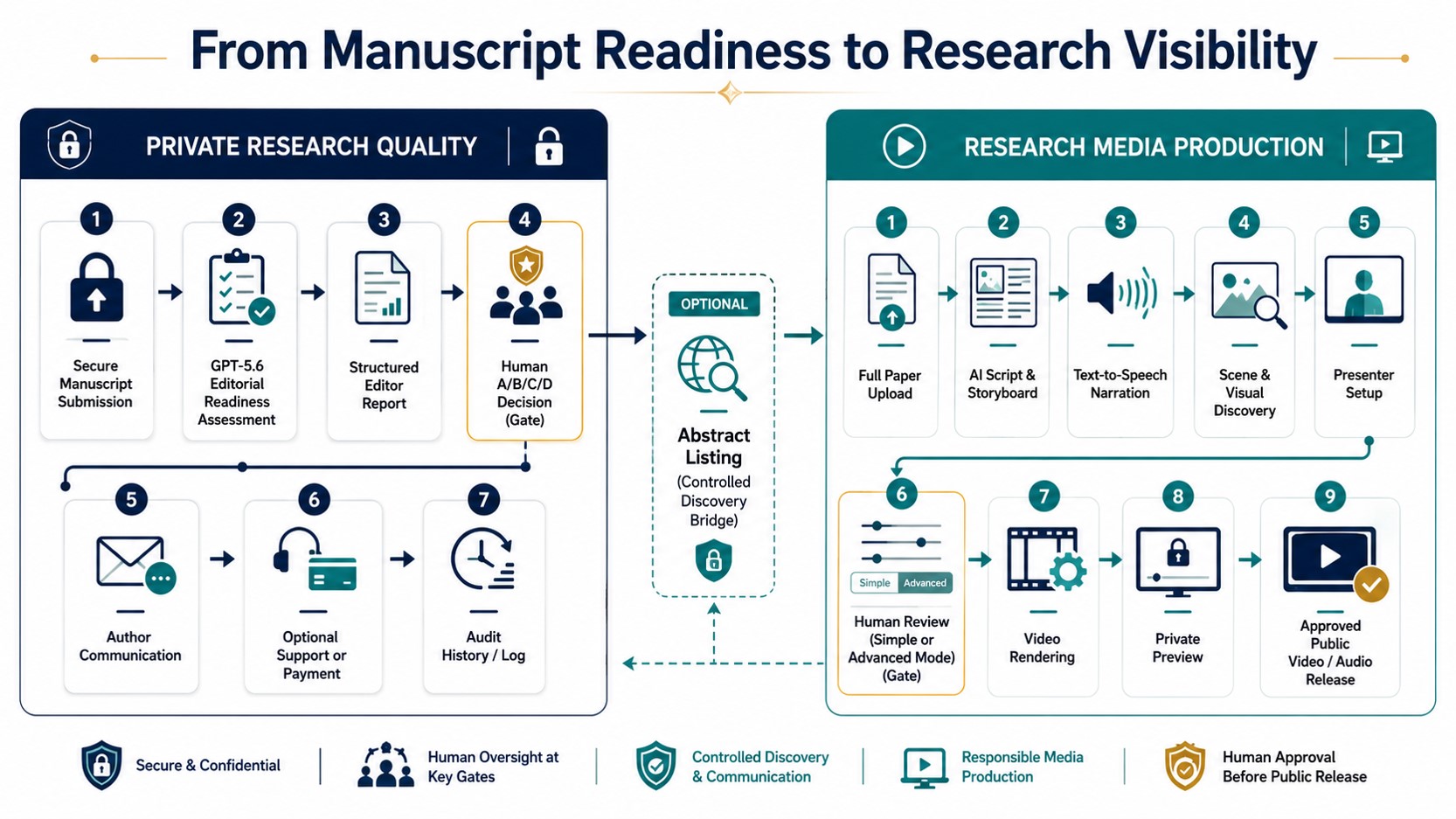
End-to-end workflow

From private quality assessment to approved public media

Editorial communication and public media release are both protected by separate human approval gates.

Add the final “From Manuscript Readiness to Research Visibility” workflow image as  rql-workflow.jpg.
Research Quality Lab workflow from manuscript readiness to research visibility
Step 1 Secure manuscript submission
Step 2 GPT-5.6 readiness assessment
Step 3 Structured internal editor report
Step 4 Human A/B/C/D decision
Step 5 Author communication and optional support
Step 6 Script, narration, scenes and visuals
Step 7 Human production review and rendering
Step 8 Approved public video and audio

Progressive disclosure

Easy for beginners. Detailed for professionals.

Simplifying the interface did not require removing the underlying production controls.

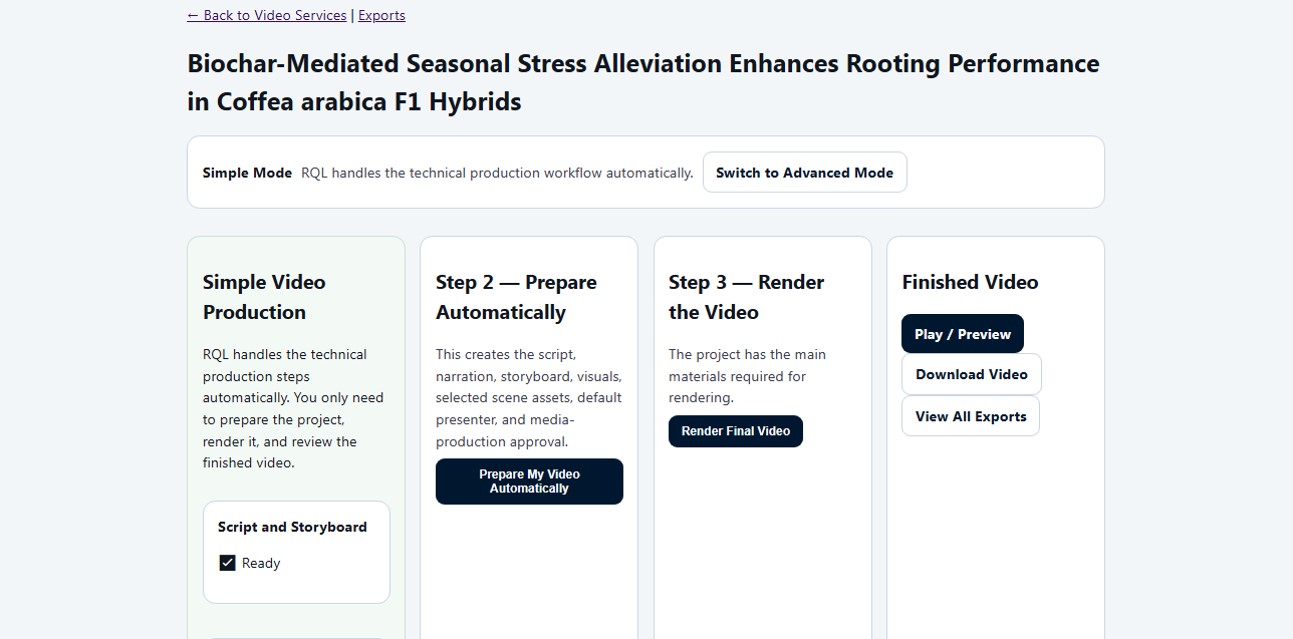
Simple Mode

A guided three-step workflow

Researchers with little production experience can prepare and render their media without operating every technical stage individually.

  • Create a project and upload or select the paper
  • Select “Prepare My Video Automatically”
  • Select “Render Final Video”
  • Preview or download the finished audio and video
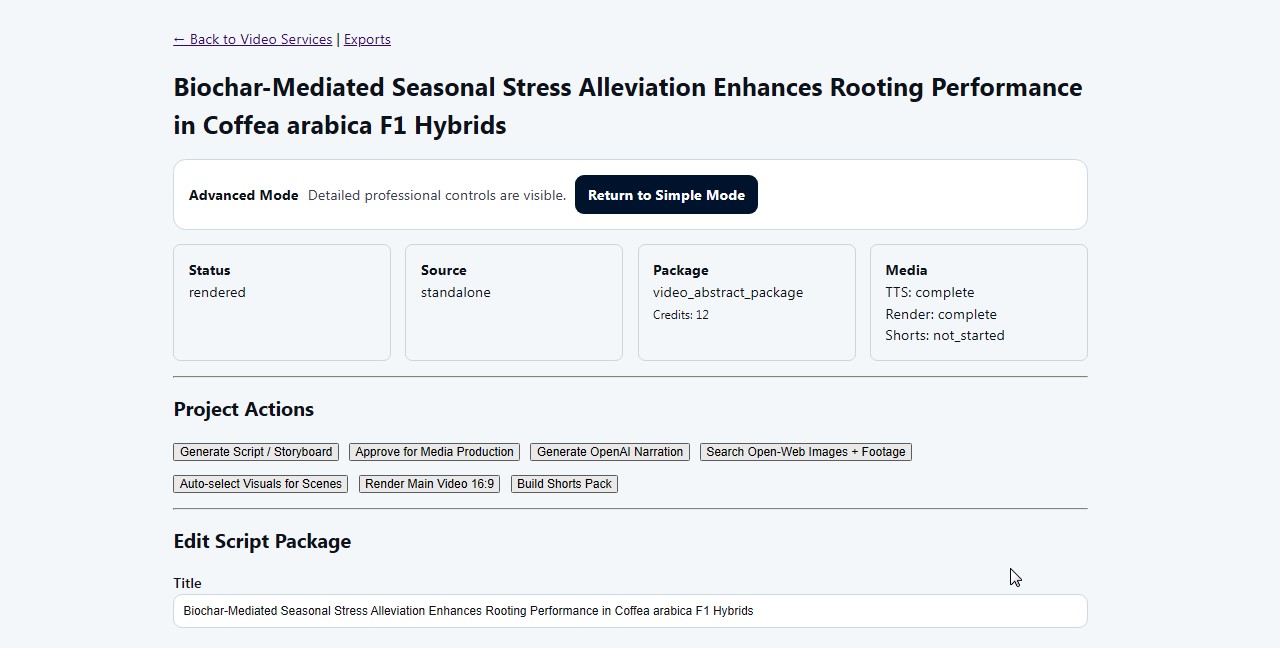
Advanced Mode

Full professional production control

Experienced users can inspect, replace or refine the automatically prepared production elements.

  • Edit script, narration and scene content
  • Review visual candidates and selected assets
  • Use paper figures and presenter assets
  • Control exports, captions and publication settings

Working product

Demonstration highlights

These are real product screens from the synthetic demonstration journal and research-media workflow.

Add 01-editorial-report.jpg
GPT-5.6 Editorial Readiness report
Editorial evidence

Structured GPT-5.6 readiness report

Shows the suggested outcome, score, evidence, concerns, limitations and recommended action.

Add 02-human-decision.jpg
Human-controlled editorial readiness decision
Human authority

Editable A/B/C/D decision

The AI suggestion is only a draft. The editor reviews, changes or overrides it before saving the decision.

Add 03-author-payment.jpg
Author communication and optional support workflow
Author experience

Communication, support and service history

Author-facing explanations remain separate from internal AI evidence, while optional support is clearly tracked.

Add 04-video-simple-mode.jpg
RQL Paper-to-Video Simple Mode
Accessible production

Paper-to-Video Simple Mode

Script, narration, scenes, visuals, presenter setup and rendering are organized into a guided workflow.

Add 05-video-advanced-mode.jpg
RQL Paper-to-Video Advanced Mode
Professional control

Paper-to-Video Advanced Mode

Users can inspect scenes, visual candidates, selected assets, presenter controls, narration and exports.

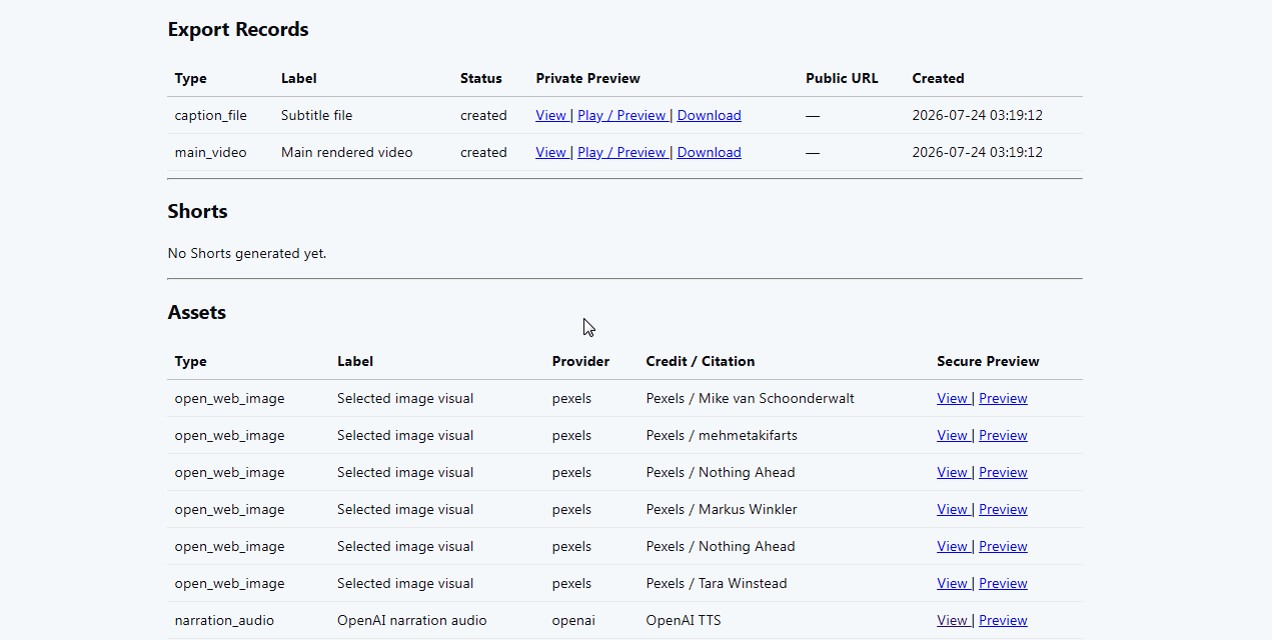
Add 06-media-output.jpg
Finished RQL video and audio output
Real output

Rendered video and narrated audio

The production workflow generates previewable and downloadable media rather than stopping at a mock interface.

Explore the demonstration

Public exploration and guided judge access

Guided reviewer access

Authorized reviewers can inspect the prepared editorial and media workflows using private demonstration credentials.

Demo editor and demo author credentials are supplied privately and are not published on this page.

Demonstration safety notice: The project uses synthetic manuscript, author, institution, payment and research records. It contains no confidential manuscript or real financial information.

Responsible AI

Human authority is preserved

GPT-5.6 provides structured assistance, but consequential editorial and publication actions remain under human control.

No automatic acceptance AI cannot accept or reject a manuscript independently.
No automatic author contact An editor reviews the separate author-facing message.
No payment-for-acceptance Optional support remains separate from editorial outcome.
No automatic public release Generated media stays private until separately approved.

Current status

A functional prototype with a clear path forward

Working and tested

  • Secure manuscript and version access
  • GPT-5.6 structured readiness assessment
  • Human-controlled editorial decision
  • Author communication and service history
  • Article-specific script and storyboard
  • OpenAI text-to-speech narration
  • Scene and visual-candidate generation
  • Simple Mode and Advanced Mode
  • Rendered video and audio downloads
  • Private draft and approved public-media architecture

Next improvements

  • Stronger discipline-aware visual matching
  • Improved typography, transitions and pacing
  • Better use of paper figures and tables
  • Transparent and animated presenter assets
  • Talking-presenter integration
  • Reliable browser-compatible H.264 encoding
  • Background production jobs and progress updates
  • Multilingual editorial and media outputs

Built with

Technology integrated around a real research workflow

Research Quality Lab is a modular Python and Flask platform combining AI analysis, secure document handling, journal workflows, research-media generation and controlled publication.

GPT-5.6 Sol OpenAI API OpenAI TTS Python Flask Jinja SQLite HTML5 CSS3 JavaScript FFmpeg Pexels API Pixabay API Werkzeug Passenger WSGI CloudLinux Secure Resources Role-Based Access Human-in-the-Loop AI

Project tags

Artificial Intelligence GPT-5.6 OpenAI Research Academic Publishing Scholarly Communication Editorial Workflow Research Quality Human-in-the-Loop Responsible AI Multimodal AI Generative AI Journal Management Manuscript Screening Research Integrity Paper-to-Video Video Abstract Text-to-Speech Research Media Science Communication Accessibility Workflow Automation Academic Technology Python Flask